

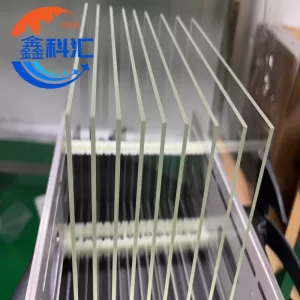
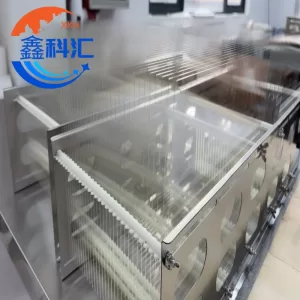
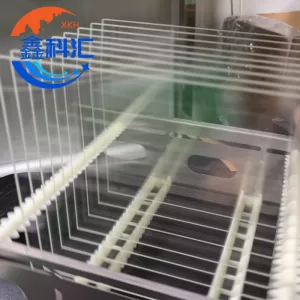
Optical Quartz Glass, also known as fused silica, is a high-purity, isotropic form of SiO₂ with exceptional optical, thermal, and chemical stability. It features low thermal expansion, high hardness, and excellent transmission across UV, visible, and infrared wavelengths. These properties make it ideal for precision optical systems, scientific instruments, and high-performance laser applications.
Optical quartz glass is categorized into JGS1, JGS2, and JGS3, each designed for specific spectral ranges, hydroxyl (OH) content, and structural characteristics. Selecting the right grade ensures optimal system performance and durability.
| Grade | JGS1 | JGS2 | JGS3 |
|---|---|---|---|
| Type | Far UV Optical Quartz | UV Optical Quartz | Infrared Optical Quartz |
| Raw Material | Synthetic SiCl₄ | Natural quartz crystal | Natural quartz crystal |
| Manufacturing | Oxyhydrogen flame fusion | Oxyhydrogen flame fusion | Vacuum electric fusion |
| OH Content | ~2000 ppm | 100–200 ppm | Extremely low |
| Metal Impurities | Very low | Tens of ppm | Tens of ppm |
| Internal Structure | Bubble-free, no particles | Minor striations/particles | Minor bubbles, striations |
| UV Transmission | ≥90% at 185 nm | Limited, cutoff ~220 nm | Low in deep UV |
| OH Absorption | Strong at 2730 nm | Moderate at 2730 nm | Minimal |
| Transmission Range | 185–2500 nm | 220–2500 nm | 260–3500 nm |
| Infrared Performance | Moderate | Moderate | Excellent |
| Applications | Deep UV optics, lasers, lithography | General UV & visible optics | IR optics, thermal imaging systems |
| Cost | High | Medium | Medium–High |
| Comparable Materials | Suprasil 1/2, Spectrosil A/B, Corning 7980 | Homosil 1/2/3, Dynasil series | Suprasil 300 |
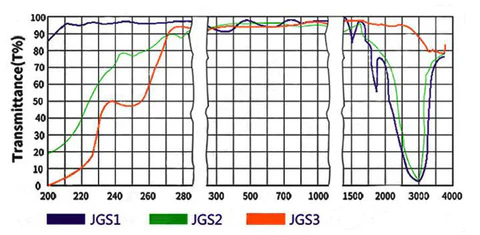
JGS1 is a synthetic fused silica produced from SiCl₄ using oxyhydrogen flame fusion. Its high OH content (~2000 ppm) ensures outstanding deep UV transmission, with ≥90% transmittance at 185 nm. It is bubble-free and highly homogeneous, making it ideal for critical UV optics.
Applications:
JGS2 is manufactured from natural quartz crystal using flame fusion. It contains 100–200 ppm OH and minor metal impurities. Its transmission covers 220–2500 nm, with possible striations in larger dimensions. Cost-effective and versatile, it is widely used for general UV-visible optical applications.
Applications:
JGS3 is produced by vacuum electric fusion from natural quartz. Almost OH-free, it offers superior IR transmission with minimal absorption. Minor bubbles or striations may exist, but it excels in applications requiring wide spectral coverage up to 3500 nm.
Applications:
Q1: Differences between JGS1, JGS2, JGS3?
A1: Raw material, OH content, impurities, internal structure, and spectral range.
Q2: Why is OH content important?
A2: High OH improves UV transmission but reduces IR performance due to absorption around 2730 nm.
Q3: Can quartz glass be coated?
A3: Yes, AR, reflective, or interference coatings can be applied.
Q4: Is optical quartz glass the same as normal glass?
A4: No. It has higher purity, lower thermal expansion, and superior UV/IR transmission.